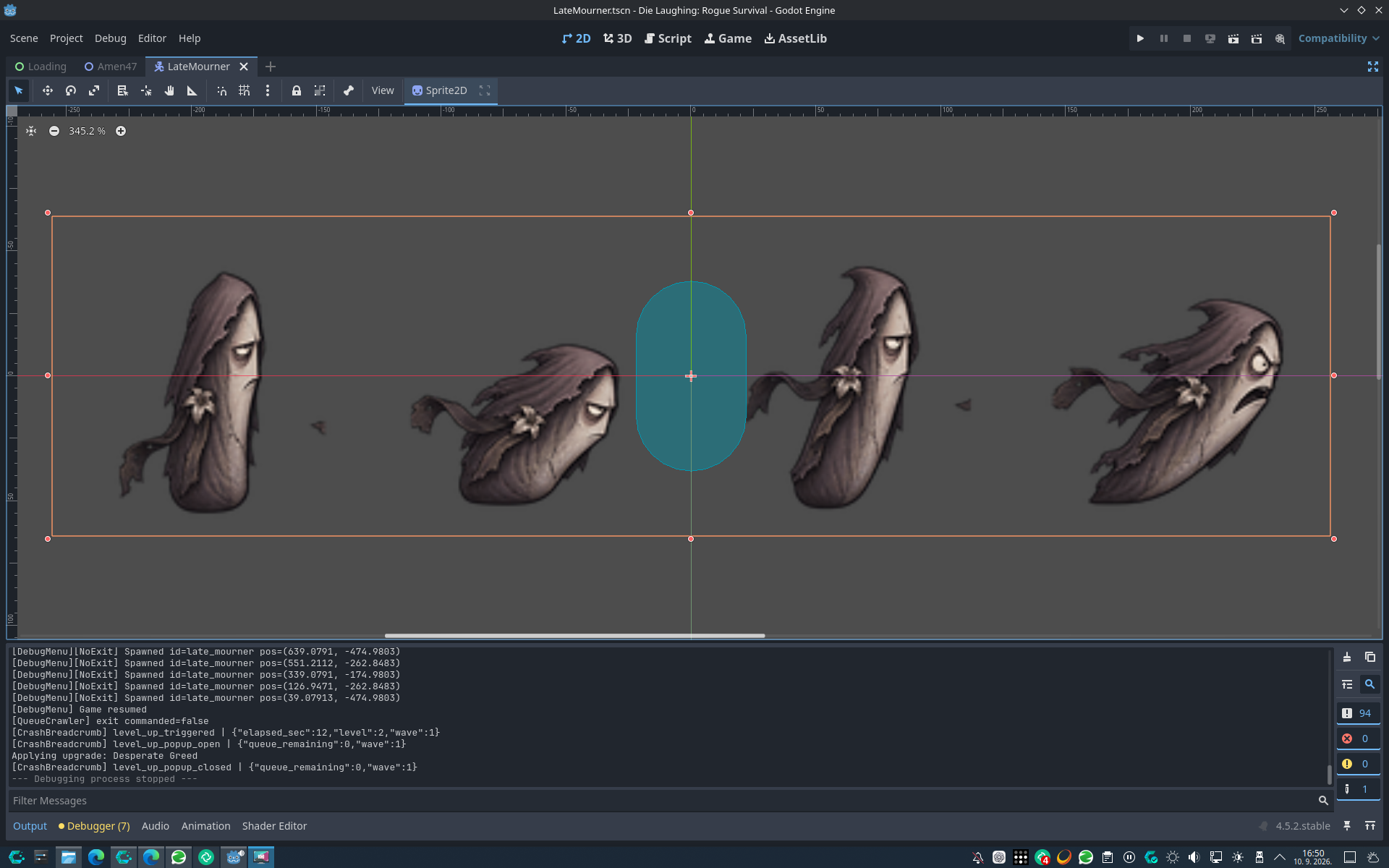
Late Mourner is one of the early enemies in Die Laughing's No Exit mode. The name says what the character feels like: a figure who has already missed the moment, but keeps drifting toward the player anyway. That idea gives the enemy a very simple job — be recognizable, unsettling, and readable before the screen fills with bodies.
START WITH THE SILHOUETTE
The first test was not animation. It was the silhouette. A tall, narrow body, heavy hair, a trailing shape behind the head, and one small contrasting detail are enough to make Late Mourner distinct from the rest of the roster. At mobile scale, those large shapes matter more than tiny facial details.
This is the useful constraint of character work for a horde survival game: every enemy needs a personality, but that personality has to survive being seen for half a second between the player, projectiles, pickups, and several other enemies. The design has to work as a thumbnail before it can work as a close-up.
The test: if the enemy is reduced to a dark shape moving across the arena, can you still tell which one it is? Late Mourner needs to pass that test before any extra detail earns its place.
FOUR FRAMES, ONE CLEAR READ
The sheet uses four compact poses: idle, move A, move B, and attack. It is a small animation set, but it covers the moments that matter most in play.
- Idle establishes the default posture and keeps the character from feeling like a static cutout.
- Move A and move B add a visible rhythm to the approach without turning the walk cycle into a distraction.
- Attack breaks the silhouette enough to communicate intent before the gameplay event lands.
The two movement frames are deliberately different, but they still belong to the same character. That balance is important: too little change and the enemy looks frozen; too much and the player reads the frames as unrelated drawings. The attack pose is allowed to be more expressive because it has a communication job, not just a looped animation job.
FROM SPRITESHEET TO GAMEPLAY ASSET
The art is authored as a horizontal sheet with matching frame cells, consistent pivots, and a shared baseline. That makes the transition from image to in-game body predictable: the character can animate without changing its collision position or suddenly appearing to slide across the arena.
The visual target size is kept independent from the source texture resolution. That means the source can be optimized later without changing Late Mourner's world scale, collision, or gameplay feel. It is a small technical detail, but it prevents art optimization from becoming a balance change by accident.
GROTESQUE, BUT NOT NOISY
Die Laughing's current character direction is intentionally economical: large color shapes, thick contours, and only the details that prove the character's role. Late Mourner keeps the strange, mournful energy of the original design while avoiding a wall of texture that would disappear on a phone screen.
The result should feel authored rather than over-explained. The hair gives the head a strong shape. The trailing fabric creates motion even when the body is moving slowly. The small flower-like detail breaks up the darker mass. Everything else has to justify its pixels.
WHY THIS MATTERS IN A HORDE
Late Mourner is not a boss and does not need a complicated attack language. It needs to create pressure through presence. When several enemies are approaching at once, the player should be able to identify the Late Mourner, understand that it is closing in, and recognize its attack pose without stopping to inspect the character.
That is why the animation pass is part of gameplay readability, not just presentation polish. A stronger silhouette and a clearer attack frame make the same encounter easier to parse, especially in the portrait layout the game is built around.
WHAT'S NEXT
Late Mourner is one step in the broader character pass for Die Laughing. The same workflow now needs to be applied across the roster: consistent four-frame sheets, stable pivots and baselines, attack poses tied to real gameplay moments, and a final phone check for readability and performance.
The goal is not to make every enemy equally elaborate. The goal is to give every enemy one clear visual idea — then make that idea survive the chaos.
Follow the project on the Die Laughing page and browse the full devlog for more behind-the-scenes updates.