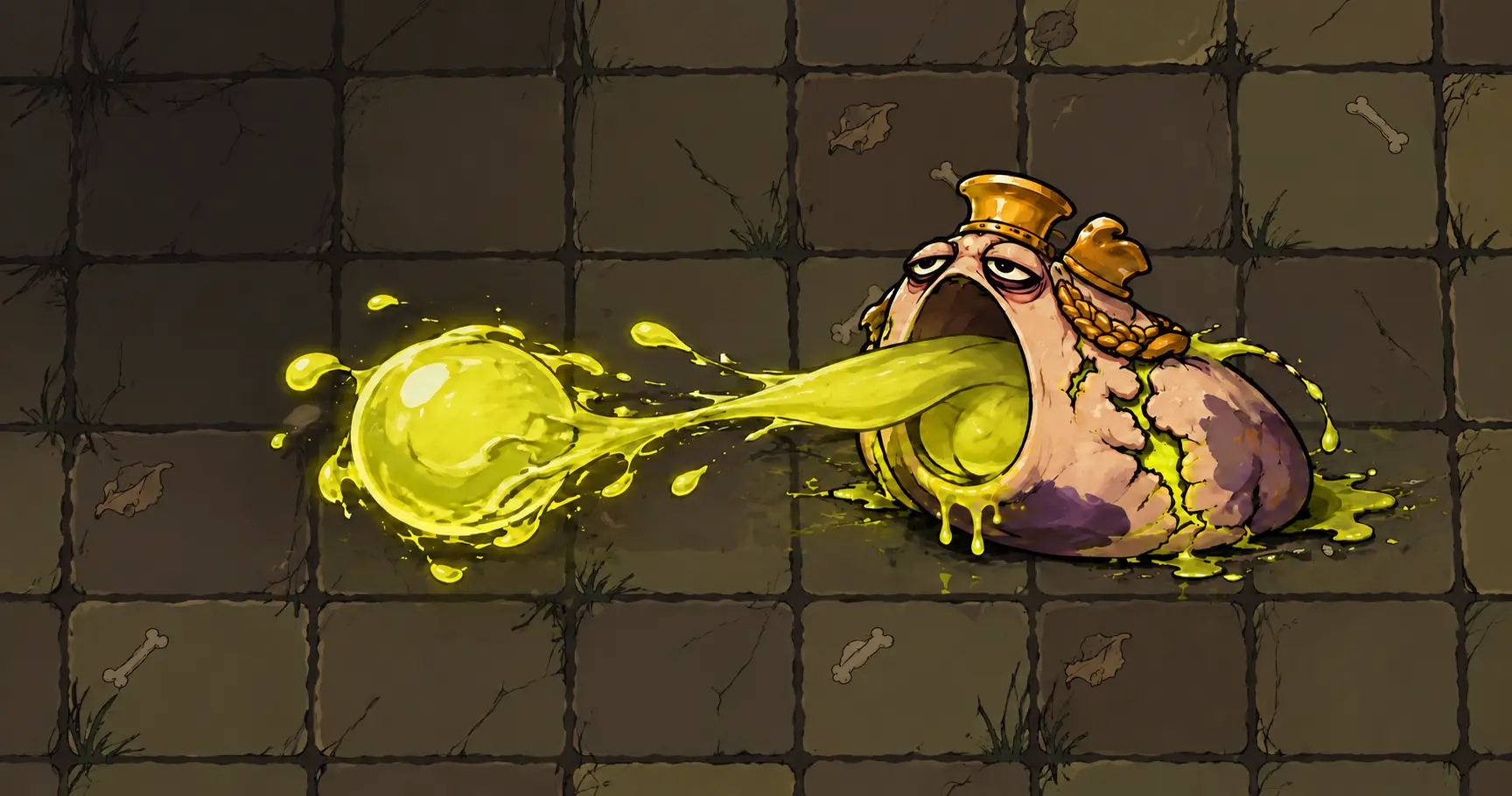
No Exit is the next major mode being prepared for Die Laughing. It is built around a larger roster of strange enemies and authored encounters, but the goal is still the same: every threat has to be readable while the screen is moving, crowded, and full of effects. Bile Cantor is one of the ranged specialists being shaped for that mode.
THE RANGED ENEMY IN THE NEXT MODE
Bile Cantor does not need to chase the player into a corner. It creates pressure by holding a little distance, marking a position, and sending a bright acid payload toward where the player was. That makes its visual language important: the player needs to recognize the body, understand the warning, and read the release before the puddle becomes part of the arena.
The original poses had the right character, but not enough movement. The idle, movement, and attack silhouettes sat too close together, so the sprite could feel static even when the gameplay event was working correctly. The new pass gives the body more compression, lean, and extension without changing what the enemy does.
FOUR FRAMES, FOUR JOBS

- Idle keeps the heavy, sleepy body readable when the Cantor is waiting for its next shot.
- Move A compresses the body into a low, forward-moving shape.
- Move B stretches the silhouette into a longer, more directional pose.
- Attack opens the mouth and throws the tongue forward so the payload launch reads immediately.
The movement frames are deliberately not subtle. A horde enemy only gets a fraction of a second to register on a phone screen, so animation needs to do more than add life. It needs to separate states.
KEEP THE BODY ON THE FLOOR
The first grounded pass exposed a familiar 2D character problem: the artwork could look like it was rotating or floating even though the collision body was in the right place. The fix was to treat the bottom of the character — not the center of the transparent sprite cell — as the visual anchor.
Bile Cantor now stretches, bounces, and reacts to hits around that bottom point. Its procedural tilt is disabled because this character reads better as a planted ranged body. The visual Sprite2D can change shape while the collision position and gameplay footprint stay stable.
The rule: art can move, squash, and speak, but the character's feet should keep telling the truth about where it is standing.
ANIMATION THAT RETURNS TO PLAY
The four-frame sheet is driven by the shared AnimationPlayer setup used by the current No Exit visual trials. Idle and movement are selected from the enemy's actual state, while the attack frame is a short override tied to the payload launch.
There was one final small bug in that handoff: because Bile Cantor has a custom movement loop for its ranged spacing, it was not advancing the shared attack timer. The result was an enemy that could remain stuck in its extended attack pose after the first launch. The timer now advances inside that custom loop, so the Cantor returns cleanly to idle or movement after the attack.
NO EXIT IS GETTING CLOSER
Bile Cantor is one piece of the larger No Exit pass: distinct enemies, readable authored encounters, consistent ground anchors, and visuals that still make sense when the arena is busy. The mode is coming soon, and the remaining work is about bringing the same level of clarity and personality across the rest of the roster.
The target is not maximum detail. It is a character that can be understood at a glance, then remembered because it has one strange idea of its own: a sleepy cantor that sings in acid.
Follow the project on the Die Laughing page and browse the full devlog for more behind-the-scenes updates.